Digital Twins: What They Are, Where They Stand, and Where They’re Heading
What Is a Digital Twin?
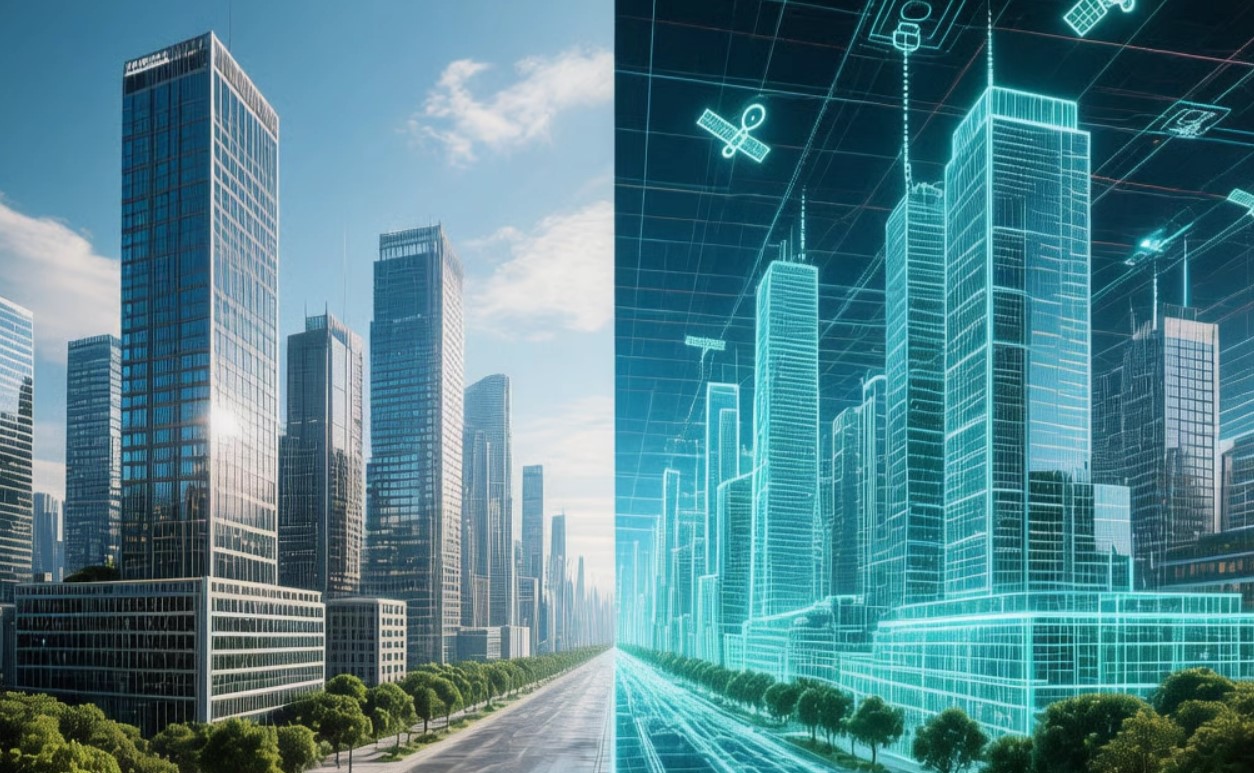
A digital twin is a virtual replica of a physical object, system, or environment, which stays connected to its real-world counterpart through live data, enabling simulation, monitoring, analysis, and optimization.
At its core, a digital twin involves three elements:
- A physical entity — a building, a wind turbine, a manufacturing line, an entire city.
- A virtual model — a 3D or data-driven representation that mirrors the physical asset in structure and behavior.
- A data connection — sensors, IoT devices, or other inputs that feed real-time or near-real-time information from the physical world into the digital model.
Crucially, a digital twin is not just a 3D visualization or a static BIM model. The defining feature is the real-time data link — without it, you have a digital model, not a digital twin.
Where Do Digital Twins Stand Today?
The global digital twin market was valued at roughly $12–15 billion in 2024 and is projected to grow at a compound annual rate exceeding 30% through 2030.
Key application areas:
- Manufacturing: Factory floors predict equipment failures and optimize throughput
- Urban planning and smart cities: Integrate GIS data, satellite imagery, building models, traffic flows, and environmental sensors
- Infrastructure and construction: Bridges, tunnels, railways — structural health monitoring and predictive maintenance
- Energy and utilities: Wind farms, power grids, and pipelines for supply optimization
- Automotive and aerospace: Pre-production simulation and in-flight engine maintenance prediction
How Different Countries Are Approaching Digital Twins
Singapore: The City-as-a-Platform
Singapore’s Virtual Singapore project is a 3D city model integrated with real-time data layers covering demographics, traffic, climate, and energy. The government treats the twin as a collaborative platform, accessible to agencies, businesses, and researchers.
Germany: Industrial Backbone
Germany gravitates toward manufacturing and Industry 4.0, focusing on factory-scale twins for predictive maintenance and production optimization.
China: Scale and Speed
China’s digital twin push is characterized by scale and deployment velocity — from district-level city twins to province-wide infrastructure monitoring. The integration of 5G, satellite remote sensing, and edge computing is notable.
Japan: Disaster Resilience via PLATEAU
Japan’s PLATEAU initiative provides open-access 3D city models for hundreds of municipalities, emphasizing interoperability and real-world applications such as disaster preparedness and mobility planning.
South Korea: National Platform, City-Level Precision
South Korea’s Digital Twin National Territory initiative and S-Map (Seoul) support urban planning, environmental analysis, and disaster management.
Where Digital Twins Are Going
- AI-powered twins moving toward autonomous decision-making
- Standardization efforts reducing fragmentation and enabling interoperability
- Satellite-based 3D reconstruction lowering the barrier to large-scale urban twins
- Edge-cloud architectures enabling responsive and powerful twins simultaneously
Key Takeaway
What underpins every successful digital twin is the same thing: an accurate, maintainable 3D model of the physical world. Without it, the twin is guessing. With it, cities, companies, and countries can plan, simulate, and act with a level of precision that was simply impossible a decade ago.
Related Articles
- 3DGS for City-Scale Digital Twins — Breakthroughs in 3DGS for Urban Digital Twins
- What is Large-Scale 3D City Modeling? — The 3D foundation of digital twins
- Get3D Mapper-SAT — Provision of 3D data from the satellite layer
- Air-Ground Fusion Case Studies — Case Studies on Digital Twins
Source: Get3D Knowledge Center