Key Functions of Content-Aware Technology
Summary: Content-aware reconstruction uses AI to identify scene elements (vehicles, vegetation, buildings, water, thin structures) and apply category-specific processing strategies.
Who This Guide Is For: 3D production teams, photogrammetry operators, and quality managers dealing with ghost vehicles, exploded buildings, vegetation noise, and other common urban reconstruction artifacts.
Get3D’s Content-Aware Technology leverages AI to fundamentally transform how 3D reconstruction handles real-world complexity. Here are the key functions in detail.
1. Moving Vehicle Removal
The Problem
Standard photogrammetry assumes the scene is static. When a vehicle moves between exposures, it appears at different positions across images and triangulation fails.
Result: ghost geometry — smeared, semi-transparent vehicle shapes fused into the road surface, duplicated car silhouettes, disrupted texture.
How Get3D Addresses It
Stage 1 — AI Detection
- Deep learning detection model identifies vehicle instances across all input images
- Each detected vehicle is masked out of the images it appears in
Stage 2 — Multi-View Consistency Verification
- Cross-validates detections across overlapping views
- Preserves parked vehicles (static across all images)
- Inpaints background road surface from adjacent clean views
Result: Clean road mesh with no ghost geometry — no manual correction required.
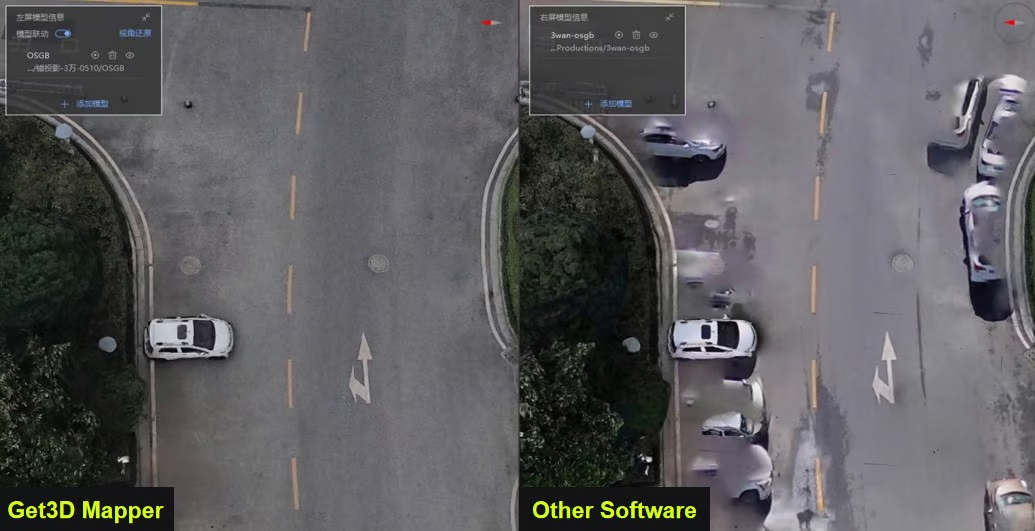
See deep dive: Moving Vehicle Removal — Full Analysis
2. Vegetation Mesh Simplification
Improves efficiency with lightweight processing of vegetation by reducing image usage and simplifying matching parameters, without affecting non-vegetation structures such as buildings.
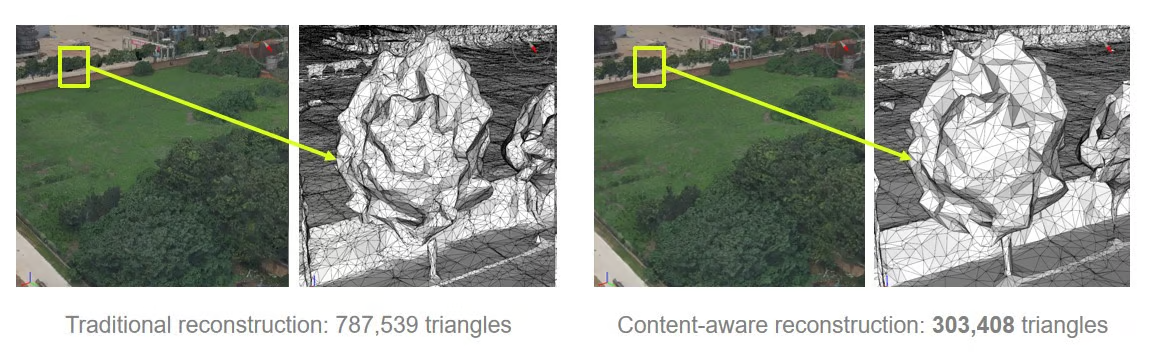
3. High-Rise Low-Overlap Optimization
The Problem
Oblique aerial photography achieves consistent ground sampling distance and image overlap at ground level. But when buildings rise significantly above the terrain, the effective overlap on vertical facades drops.
Consider a typical urban capture configuration:
- Ground overlap: 80% lateral, 5 cm GSD
- Rooftop overlap (for a tall building): as low as 40%, 1 cm GSD
The result of insufficient facade overlap is the well-known “exploded building” artifact: facades that appear shattered, fragmented, or extruded outward from the building footprint.
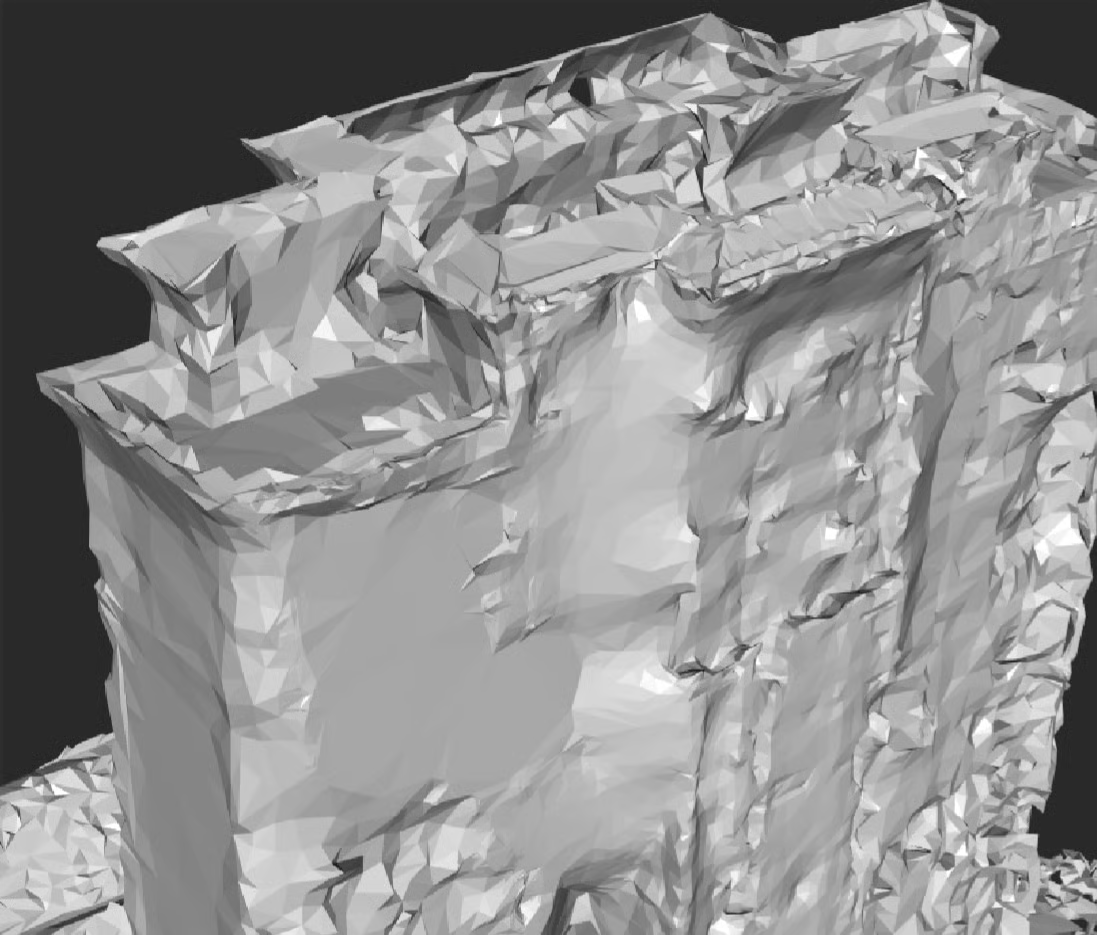
How Get3D Addresses It
Use AT optimization to reduce ~80% manual modeling work and significantly improve production efficiency.
Result: During reconstruction, low-overlap high-rise areas are optimized and adjusted to mitigate “exploded building” artifacts, achieving a 90% optimization rate.
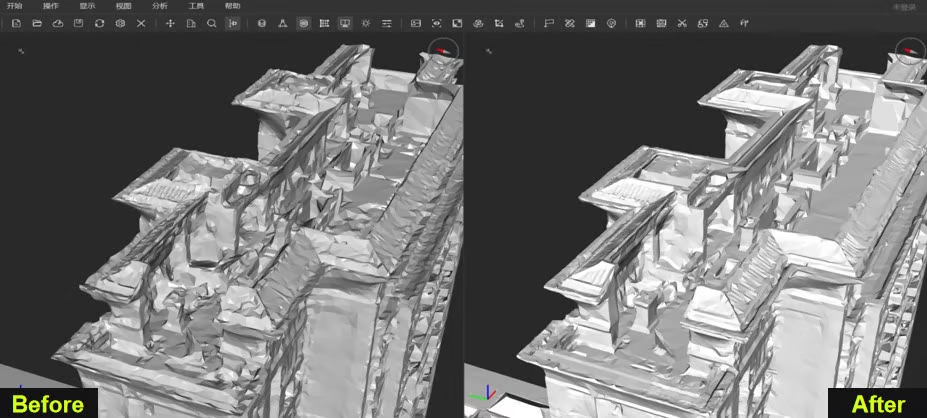
4. Thin Structure & Hole Repair
The Problem
Thin structures are a fundamental challenge for photogrammetric reconstruction. Fences, signboards, utility poles, guardrails, and overhead cables are physically real features, but they are so narrow that they appear in only a fraction of overlapping images, and depth estimation across their surfaces is unreliable.
How Get3D Addresses It
Content-aware reconstruction handles thin structures through a multi-stage pipeline:

Key innovations in this pipeline:
- Thin structure detection flags these elements before reconstruction
- Adaptive weighted meshing adjusts triangulation to span gaps and produce coherent surfaces even with sparse point support
- Independent front/back texture mapping ensures both sides of flat vertical structures are correctly textured
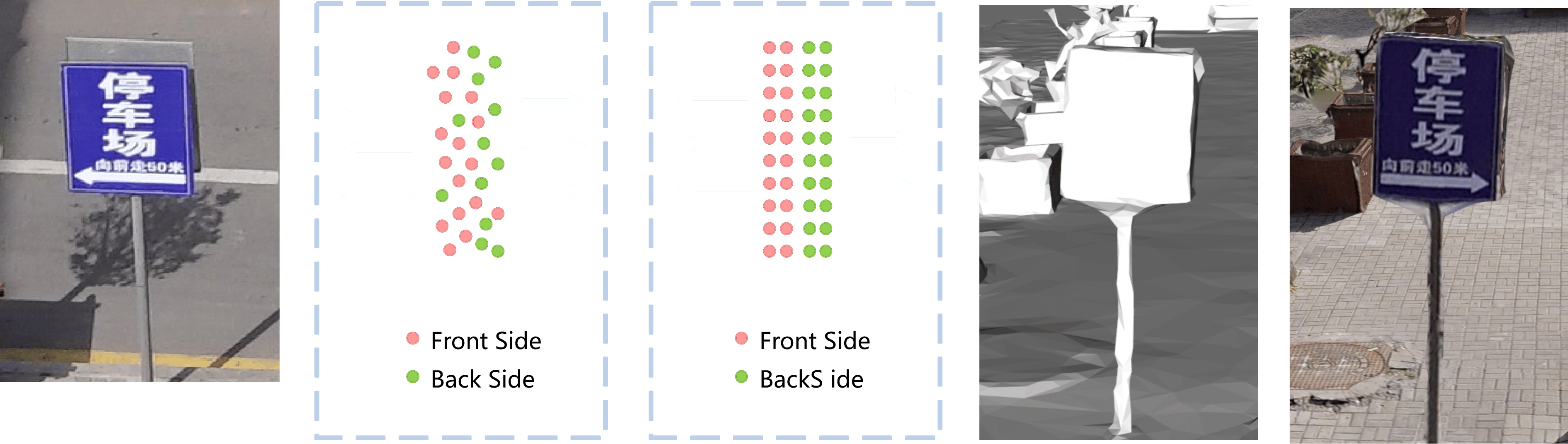
Result: Thin structures represented as coherent, textured surfaces with both sides correctly resolved.
5. Feature-Limited Area Reconstruction
6. Water Detection & Fill
Related Articles
- What Is Content-Aware Technology? — Overview and paradigm
- Moving Vehicle Removal — Deep dive on vehicle ghost removal
- Object-Level Modeling — Beyond removal to entity recognition
- Get3D City Modeling Solution — Real-world application context
Source: Get3D Knowledge Center